
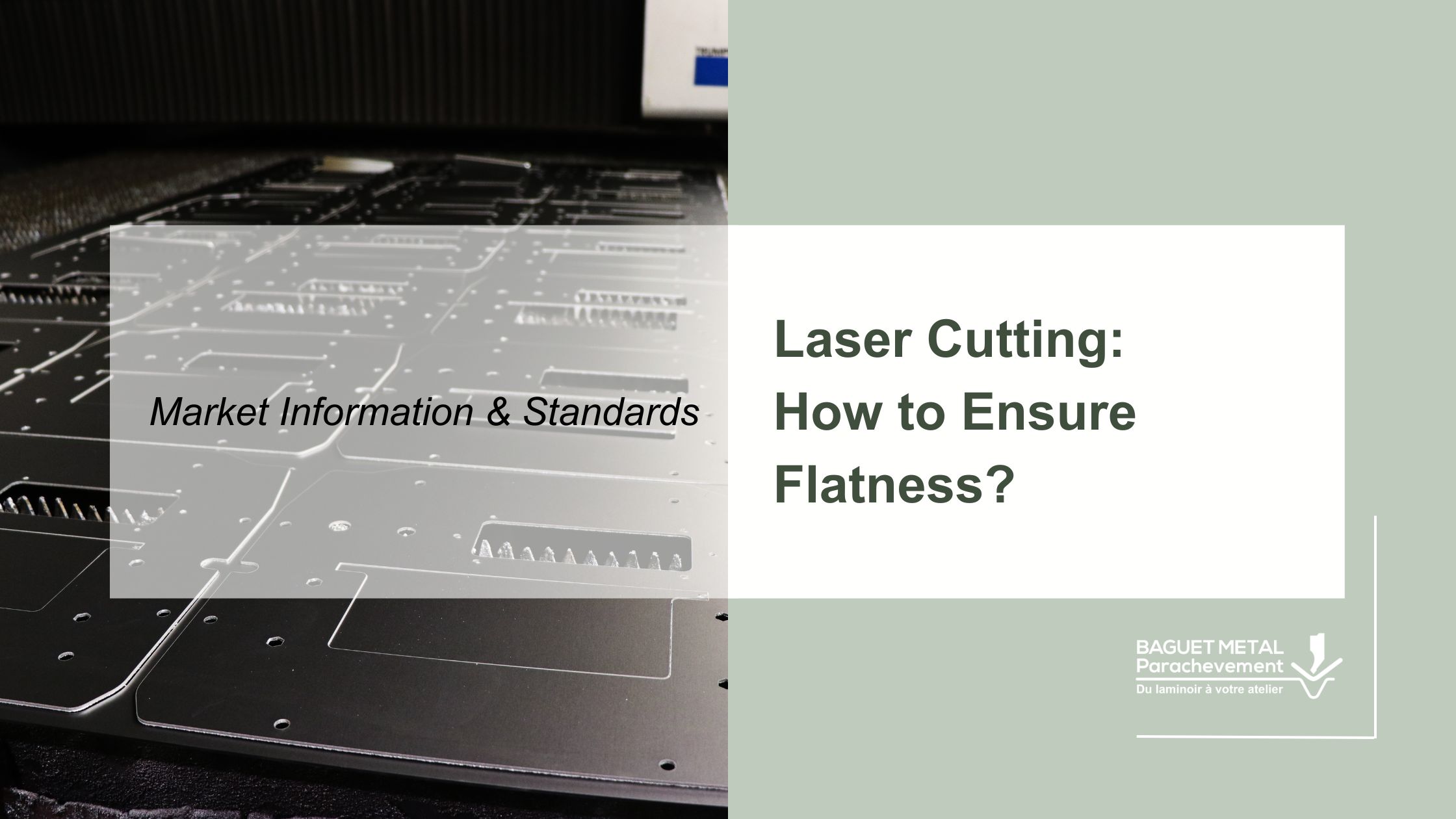
A sheet with flatness defects, even invisible to the naked eye, can cause damaged laser heads, costly production stops, out-of-tolerance parts and massive scrap.
Ensuring flatness before laser cutting is therefore not a quality detail: it is an industrial prerequisite. It requires full control of the chain, from coil uncoiling to dimensional inspection on the laser bed. In this article, we dissect the technical stakes, the origins of flatness defects, the industrial leveling solutions and the standards in force. You will find the methodology applied at Baguet Métal Parachèvement to deliver perfectly flat, stable sheets ready for precision laser cutting.
Laser cutting uses a focused light beam (fiber, CO₂) that locally melts and vaporizes the metal, assisted by a gas jet (nitrogen, oxygen, compressed air). The height of the nozzle above the sheet is servo-controlled by a capacitive sensor that maintains a typical distance of 0.5 to 1.5 mm. This servo control is designed to compensate for very small variations, not to recover a sheet warped by several millimeters.
When a non-flat sheet passes under the laser, several problems appear simultaneously:
In a laser cutting workshop running 3 shifts, the hourly machine rate is between €80 and €250 depending on power and technology. An hour of unplanned downtime due to collision or rework therefore represents a significant direct loss, not counting scrap. The profitability of a laser workshop depends as much on input material quality as on machine performance itself.
Understanding the origin of defects is the first step to eliminating them. Four families of causes can be identified.
A sheet delivered as a coil was wound hot then cooled under tension. The material retains a "memory" of this curvature: when unwound abruptly, it shows residual curvature (camber), sometimes associated with longitudinal waviness or floating edge defects.
Hot then cold rolling creates asymmetrical internal stresses across the sheet thickness. As long as these stresses are not balanced, the sheet continues to deform after each operation (cutting, drilling, welding), even partially.
According to EN 10029, hot-rolled plates may show in standard delivery flatness defects ranging from 6 mm to 18 mm over a 1,000 mm reference length, depending on the flatness class (N, L or S). Without specific leveling, these tolerances are too wide for precision laser cutting.
Forklift handling, poorly designed storage (sheets resting on irregular supports, stacked loads), long-distance road transport can introduce localized deformations. A perfectly flat sheet on delivery can become warped again after prolonged storage.
Paradox: laser cutting itself can generate flatness defects. The thermal gradient along the cut contours releases residual stresses, which translate into post-cut deformations, particularly visible on perforated parts (skeletons) in HSLA or stainless steel.
This standard defines three flatness classes for plates over 3 mm thick:
For a 6 mm thick plate in 1,500 × 3,000 mm, the maximum flatness values are typically:
For thicknesses up to 3 mm delivered in coils or sheets, this standard distinguishes two classes: normal tolerance (PT.A) and reduced tolerance (PT.B). Class PT.B is required for fine laser cutting applications.
Beyond the norms, industrial laser cutting practice typically requires flatness below 2 mm over 1,000 mm. This requirement can only be achieved with precision leveling integrated into the production chain.
Our reference solution consists of receiving coils directly at our facility and transforming them into flat sheets at exact format, in a single continuous operation. The process chains four steps:
For the most severe requirements (flatness below 1 mm/m on HSLA or stainless steel), a second pass on a precision leveler (typically 15 to 25 small-diameter rollers) finalizes dimensional stabilization. This process imposes slight surface plastic deformation that durably balances internal stresses.
Each incoming coil is verified on entry: material certificate 3.1 according to EN 10204, dimensional check, verification of absence of surface defects (rust, scratches, handling marks). Coils are stored under controlled conditions (temperature, humidity).
Our operators do not use generic settings. For each material delivery, leveling parameters (roller pressure, spacing, speed) are adjusted based on grade, thickness, actual measured thickness and initial coil condition. This manual adaptation, the fruit of forty years of experience, is the key to dimensional stability of delivered sheets.
At line exit, each batch is checked according to the following criteria:
Sheets are stacked on suitable pallets, wedged and wrapped to prevent any deformation during transport. On request, we deliver sheets directly to the customer's laser table, ready to be loaded.
Our quality system integrates systematic feedback on any laser cutting incidents experienced at the customer site. Any non-conformity triggers a root cause analysis and parameter adjustment for subsequent deliveries.
Even with perfectly flat sheets, certain precautions on the laser workshop side optimize results:
Let's take the concrete example of a lifting equipment manufacturer producing 12,000 units per year of a S355 chassis in 8 mm thickness. Before integrating our uncoiling + laser cutting solution, the customer received EN 10029 class N standard sheets, which required manual leveling on the bed (1.5 h/day) and generated a 4 % scrap rate at the laser exit.
Since the implementation of our integrated chain (coils received, leveled to tolerance below 0.8 mm/m, cut to optimal laser format, delivered just-in-time), the customer has:
Ensuring flatness before laser cutting is neither a luxury nor a quality detail: it is a fundamental economic condition. Every euro invested in precision leveling translates into several euros saved downstream, in laser productivity, scrap reduction and assembly dimensional reliability.
At Baguet Métal Parachèvement, precision uncoiling and leveling are the first step of our industrial finishing offer. We deliver perfectly flat, stable and traced sheets, ready for laser cutting, on all steel grades and thicknesses up to 15 mm. Our leveling line and operator expertise allow us to guarantee flatness tolerances down to 0.5 mm over 1,000 mm, well beyond the EN 10029 class S standards.
Want to secure your laser cutting and optimize your part cost?