In metal transformation, two processes produce parts with straight angular geometries: bending on a press brake, and cold roll forming on a multi-stand line. At first glance, the outcome looks similar: a flat sheet becomes a shaped part ready for assembly. In reality, these two technologies follow radically different industrial logics. One is flexible and fits unit pieces or mid-volume runs. The other is highly productive but requires a significant tooling investment.
Choosing the wrong process exposes you to cost drift (up to 60 % gap on multi-thousand-meter runs), to lead times incompatible with your production planning, or to geometric limitations that force expensive rework. At Baguet Métal Parachèvement, we have supported industrial manufacturers through this strategic choice for more than 40 years. This article gives you the technical and economic keys to decide between bending and roll forming, based on your volumes, geometric constraints and cost objectives.
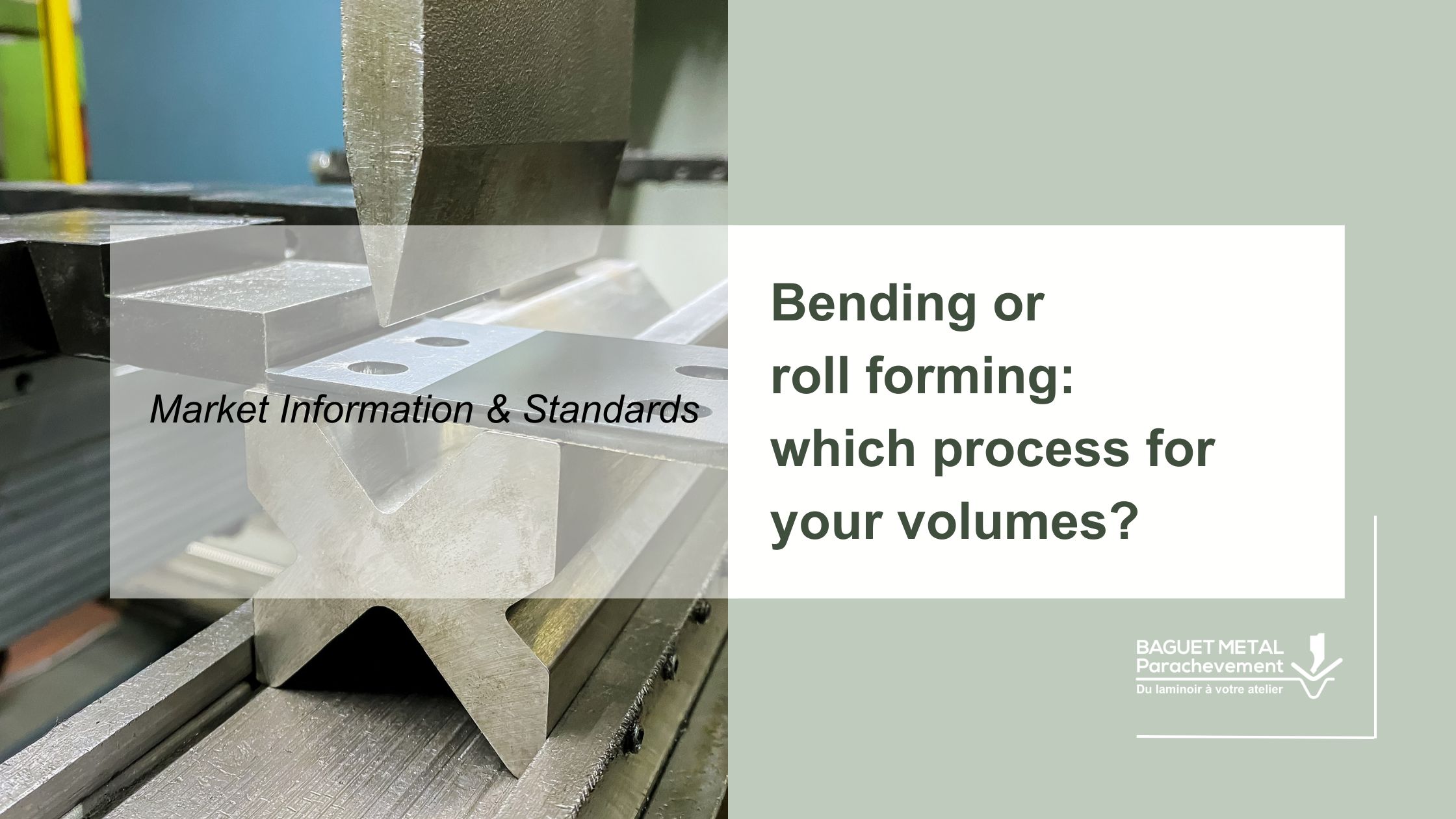
Bending is a plastic deformation process that curves a flat sheet along a straight line using a press brake equipped with a punch (male die) and a V die (female die). The descending force of the punch imposes an angle on the sheet, defined by the penetration depth and the tooling geometry.
Bending is unbeatable for unit parts, prototypes and mid-volume series, especially when geometry includes multiple non-parallel bends, closed bends (flattened folds), pre-drilled holes or complex cut-outs integrated before bending. The flexibility of the tooling (interchangeable punches and dies) allows switching from one reference to another in a few minutes.
Conversely, bending reaches its limits as soon as volumes exceed a few hundred to a few thousand identical parts per year. Cycle time (manual or robotic positioning, successive folds, quality control) becomes a bottleneck, and unit cost stays high even with robotic bending.
Cold roll forming progressively deforms a metal strip unwound from a coil, by feeding it through a succession of rolls (between 8 and 30 pairs depending on profile complexity). Each roll stand imposes an incremental deformation until the final cross-section is achieved. The profile exits continuously, cut to length by the integrated flying shear.
This is by nature a series process: it requires the design and manufacture of a dedicated roll tool set for each cross-section. This initial investment, typically between €15,000 and €80,000 depending on complexity, is only amortized at significant volumes.
Cold roll forming offers unmatched geometric regularity: every meter produced is strictly identical to the previous one. This consistency, combined with high output rates, drives unit cost down as soon as volumes exceed a critical threshold. The increased rigidity of the profile (cold-work hardening) often allows reducing thickness by 10 to 15 % at equal mechanical performance, generating direct material savings.
On the other hand, roll forming requires a volume commitment. Changing the cross-section requires designing and manufacturing a new roll tool set, an operation that takes 4 to 12 weeks depending on complexity. Geometry modifications during a series are impossible without new tooling. Finally, some geometries (T-shaped bends, welded closed sections, very tight bends) cannot be produced, or require additional operations downstream.
| Criterion | Bending | Cold roll forming |
| Optimal volume | 1 to 5,000 parts/year | From 10,000 m / year |
| Tooling investment | Low (standard tools) | High (€15,000 to €80,000 / profile) |
| Setup lead time | A few days | 4 to 12 weeks |
| Geometric flexibility | Very high | Low (fixed cross-section) |
| Unit cost at high volume | High | Very low |
| Practical maximum length | 12,500 mm | Unlimited (12 to 24 m common) |
| Straightness tolerance | Good | Excellent |
| Modification during run | Possible | Impossible without new tooling |
| Typical throughput | 30 to 200 bends/h | 600 to 3,600 m/h |
| Typical thicknesses | 0.8 to 40 mm | 0.4 to 6 mm |
This is the dominant criterion. Below 2,000 linear meters per year of the same reference, bending is systematically more economical because the amortization of the roll tool set is not reached. Between 2,000 and 10,000 meters, the analysis becomes nuanced and depends on the three following criteria. Above 10,000 meters, roll forming becomes almost essential to stay competitive.
If your design is frozen and validated for the next 5 years (for example, standardized roof purlins for a building constructor), roll forming makes full sense. If your product evolves each season, or if several variants coexist (different lengths, variable hole patterns, similar but distinct cross-sections), bending preserves your industrial agility.
Roll forming cannot produce transverse bends, end-of-profile holes, slotted cut-outs or integrated chamfers without additional operations (in-line punching, downstream drilling). Bending, combined with upstream laser cutting, integrates all this preparation in a single flow. On parts with intensive finishing, bending may therefore remain economically relevant even at high volume.
If you need profiles of 16 meters or more in a single piece (warehouse frame trusses, cladding rails, photovoltaic mounting rails), only roll forming is technically viable. Bending is limited by the press brake bed length, generally 12,500 mm maximum.
Our European multi-site organization offers both processes under one technical and quality responsibility. Bending is concentrated on our French, Italian and Spanish sites, with a fleet of CNC press brakes from 200 to 2,000 tons and lengths up to 12,500 mm. Cold roll forming is driven from our Portuguese site, dedicated to high-volume production, with an integrated engineering office capable of designing and implementing your custom roll tool sets.
This integration lets us approach your project without technological bias: we analyze your specification, simulate full costs over 1, 3 and 5 years, and recommend the process that is objectively the most relevant. In some cases, we combine both: roll forming for the main lengths and bending for end components, optimizing both unit cost and assembly flexibility.
Bending or roll forming: there is no universal answer, only an answer tailored to your project, your volumes and your industrial horizon. The simultaneous mastery of both processes is one of the key differentiators of Baguet Métal Parachèvement: we are neither a bending shop pushing for bending, nor a roll former pushing for roll forming. We are your industrial partner, free to recommend the solution that serves your competitiveness.
You have a metal forming project and want to objectify the choice between bending and roll forming? Our technical teams analyze your specification within 24 hours and deliver a quantified recommendation, ready to feed your industrial business plan.